
Showing posts with label eating. Show all posts
Showing posts with label eating. Show all posts
Monday, 2 December 2019
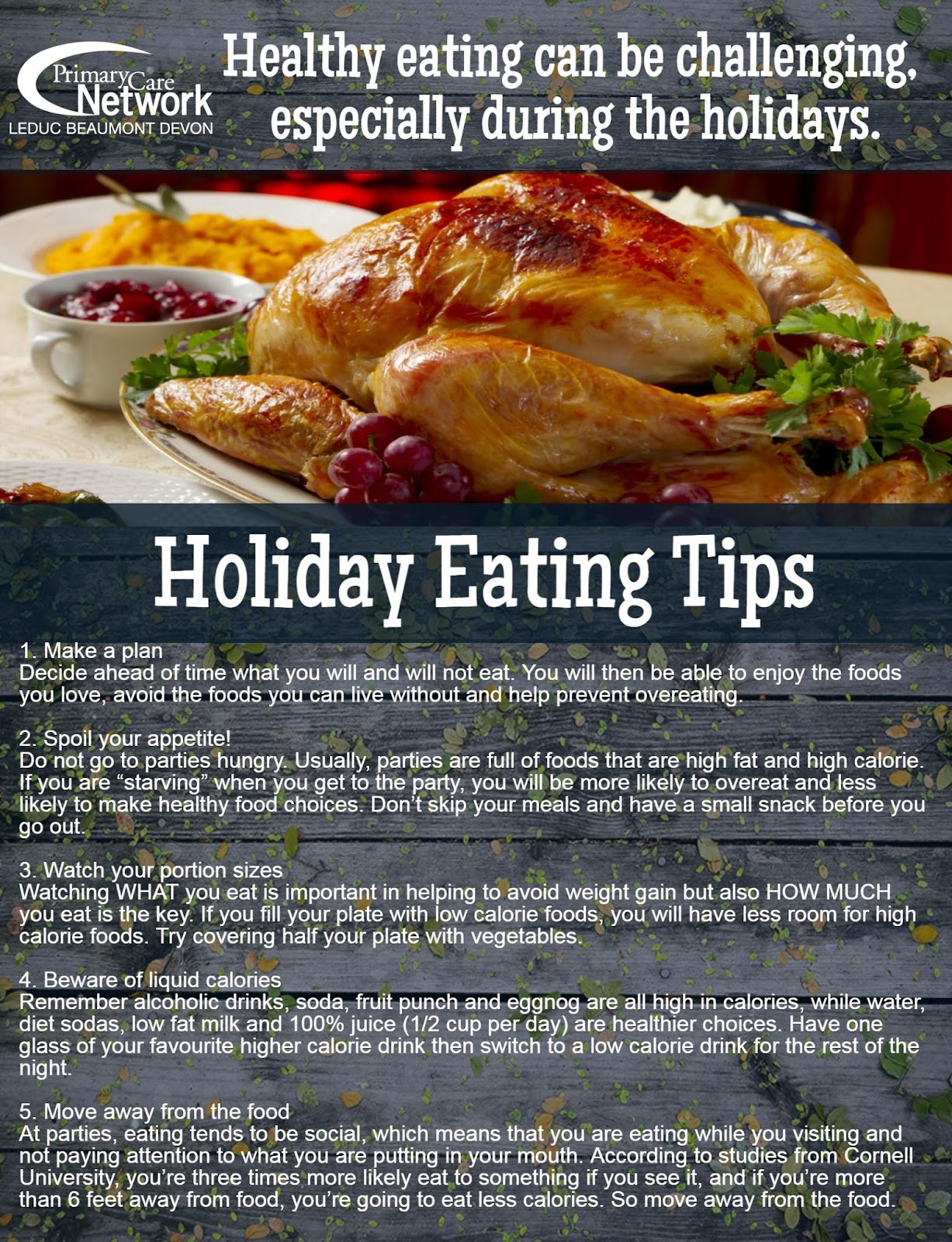
Holiday Eating Tips
The holiday season is finally here! That means lots of get togethers with family, friends, neighbours and coworkers. That also usually means food and drink will be present. Here are some holiday eating tips to keep you on your healthy lifestyle journey:


Monday, 22 July 2019
Fall 2019 Workshops

To register for Grief & Loss, Your Best Weight, Child/Teen Anxiety or Happiness Basics, please visit our website at www.lbdpcn.com or call the office at 780-986-6624.
To register for Heart Health, Diabetes Healthy Eating, Taking Charge: Daily Management of Type 2 Diabetes, Better Choices, Better Health Chronic Pain Self-Management, please call Alberta Health Services at 780-401-2665.
Thursday, 7 March 2019

Thursday, 29 March 2018
Easter Holiday Eating Tips
Maintaining healthy lifestyle choices can be extremely difficult, especially during the holiday season. Here are some times from our Registered Dietitians on how to keep on track.

Wednesday, 14 December 2016
Monday, 14 December 2015
Holiday Eating
Ask the Intern-
Holiday Eating
Let’s be honest.
The holidays are a great time to enjoy family, friends
and good food. However, this is also a time where lifestyle goals may be put to
the test. Having a plan going into this season can relieve some of the stress.
Here are a few tips to keep in mind when making your plan for the holidays:

1.
Plan to keep journalling. Thinking about ditching your
journal for the holidays? The temptation can be great, especially when your
regular routine is changed. This might be a good time to reflect on the reasons
you are journalling. Recording intake, activity or emotions makes us aware of
our behavior. Journalling in and of itself can be enough to improve what we
eating or increase activity. Journalling during the holidays can be great
learning experiences allowing us to recognize differences in behavior during
these times. If you do one thing and one thing only during the holidays,
consider journalling. Download a copy of our 3 Day Food Journal by clicking here.
2.
Plan to enjoy your favorites. Special events and family
gatherings tend to center around food. Planning to resist all of the high
calorie goodies offered may be an unrealistic goal. On the other hand, planning
to eat everything you want may make it difficult to pick up where you left off
before the holidays. Try to find a compromise. When going to family gatherings
or dinners, take some time to look at everything offered before you dish up.
Choose one or two of your high calorie favorites and fill the rest of your
plate with healthy food from the 4 food groups.
3.
Plan to have regular meals. The holidays can be a busy
time when meals may be skipped. Skipping meals makes it hard to stay on track
with lifestyle goals. It is also a difficult habit to get out of after the
holidays. Instead of “saving” calories for big meals, eating regularly before
the meal can help keep you full and prevent you from overeating. Whether you
are at home, on the road or staying with relatives, plan to have regular meals
and snacks during the day. Download a copy of our Meal Plan template, here.
4.
Plan to say no (thank you). It is likely not everyone
you see this holiday season will know about your lifestyle goals. People tend
to be more generous during the holidays which leads to more offering of food
and drinks. Do not underestimate the power of the phrase “No thank you, I’m
full”. If you find you need more support during the holidays, talk to your
family or friends about the things you are working on.
Having a plan can give you more confidence going into the
holidays. Use these tips or create your own to stay on track with your
lifestyle goals during this time. Most importantly, find out what works for you
and enjoy the season.
~ Sara Knodel is a Dietetic Intern at the Leduc Beaumont Devon Primary Care Network.
Tuesday, 9 December 2014
How to keep lifestyle goals throughout this holiday season
Everywhere you look there are signs of holidays; snow, lights, decorations, Christmas trees all in preparation for the season. Unfortunately holidays do pose challenges when it comes to watching our portions and choosing healthy options, given all the extra temptations and yummy goodies everywhere you turn. Just because it’s the holidays does not mean we can’t try to incorporate some healthy habits to keep us on track with our lifestyle and health goals.
Check out these two handouts called Healthy Holiday Eating and Eating Out the Healthy Way for some great tips!
These tips don’t just refer to the holiday season, any special occasion or time we are eating away from home still pose challenges to lifestyle goals and that these tips can also be used in those situations.

Check out these two handouts called Healthy Holiday Eating and Eating Out the Healthy Way for some great tips!
These tips don’t just refer to the holiday season, any special occasion or time we are eating away from home still pose challenges to lifestyle goals and that these tips can also be used in those situations.
Andrea Shackel is a Registered Dietitian and Certified Diabetes Educator at the Leduc Beaumont Devon Primary Care Network.
Thursday, 23 October 2014
Goodbye Mealtime Struggles
Alberta Health Services offers a FREE workshop on mealtime struggles for parents of children 6 months to 5 years old.
Join an introductory discussion with other parents, a pediatric Occupational Therapist (OT) and a Registered Dietitian (RD).
- Learn more about how children grow and develop eating skills.
- Explore the many reasons behind meal time struggles, and decide which first step strategies best fit your child and family.
- Learn about setting a consistent routine, connecting with your child, introducing healthy new foods and appropriate portion sizes.
Options for follow-up by an OT or RD are reviewed at the workshop.
This workshop is suitable for parents of children who do not have complex medical/feeding concerns or have had extensive feeding intervention.
Registration is required. Childcare is available.

Friday, 10 October 2014


Thursday, 5 December 2013
Top 10 Healthy Holiday Habits
The holidays are coming and with it are many health challenges. Here are 10 tips on maintaining your healthy lifestyle.
Click each page to view larger.


Friday, 9 November 2012
Healthy Eating for Diabetes: Myths and Facts
1. People with diabetes should only eat a special “Diabetes Diet”. Myth or Fact?
Myth - For people with diabetes, healthy eating is no different than healthy eating for anyone else. We do know that when we make healthy food choices (watching portion sizes, eating fruits and vegetables, limiting high fat and high added sugar foods) we can better manage diabetes. We also know that engaging in an overall healthy lifestyle behaviour including physical activity, not smoking, limiting alcohol and managing stress also play a very important role in managing diabetes.
2. People with diabetes should not eat carbohydrates. Myth or Fact?
Myth- Carbohydrates are the main source of energy in food, providing us with many important nutrients to stay healthy. People often think of carbohydrates as just bread or potatoes however, carbohydrates are found in all the food groups; milk, yogurt, fruit, vegetables, cereals, breads, rice, pasta, beans and lentils, which are all part of a balanced diet. Because carbohydrates have the biggest effect on blood sugars, it is important to spread them out over the day and to be mindful of your portion sizes.
3. People with diabetes should not eat bananas or grapes. Myth or Fact?
 Myth - Any foods in moderation can be part of a well-balanced diet. Fruits and vegetables are a very important part of healthy eating and should not be eliminated. Keep in mind that often once we hear “diabetes” we feel that we need to change everything in our diet. However, while you may be motivated to make many changes all at once, we recommend starting with small changes to your lifestyle to result in big change in your health over time.
 Please refer to these interactive web series on Small Changes for Healthy Living:
Healthy Living Series
Dietitians of Canada
Andrea Lewis is a Registered Dietitian and Certified Diabetes Educator with the Leduc Beaumont Devon Primary Care Network.
Friday, 13 July 2012
10 Travel Tips for People with Diabetes
Summer is here and that means summer holidays, camping and sometimes those surprise trips! For people with diabetes, being prepared for holidays and trips and can reduce your stress and make sure you keep healthy when you get there.
1. Visit your doctor of health care team several weeks before your holiday. You will want to discuss and review your medications, meal timing, times zones and if there are any required vaccinations for that area.
2. Purchase travel insurance and ensure it covers pre-existing health conditions such as diabetes.
3. Be sure to take an updated copy of your prescriptions medications, including your insulin and consider getting a medic alert bracelet or necklace that indicates you have diabetes and your treatment plan.
4. Pack your medication, blood sugar meter and supplies in more than once place (in you’re your luggage and in your carry-on) to make sure you are covered in case your bag is misplaced for a few days or even lost.
5. Test your blood sugar regularly. This will help you know if your blood sugars are in the target range.
6. Stick to your regular mealtime schedule including breakfast, lunch and dinner. Wherever you go, pack some snacks (apples, bananas or cheese and crackers) in case you are unable to eat at your next scheduled meal time. Make sure to also take quick-acting sugar such as juice or glucose tablets in case your blood sugar becomes too low. Make sure someone in your group knows how to recognize signs of a low blood sugar and what to do.
7. Pack an extra supply of insulin pen/syringes and an extra meter and log book. Make sure to take a container for sharps disposal.
8. Wear well worn, closed-toe shoes. Inspect your feet daily and try to avoid walking barefoot. Make sure you take care of any foot conditions prior to your holiday.
9. If staying in a hotel/motel, reserve a room with a kitchenette so that you can prepare meals in your room. Bring a cooler if a kitchenette is not available, so that you can keep essentials in your room. Ask if a continental breakfast is included at the hotel/motel. Are there restaurants or grocery stores nearby?
10. Stay hydrated and incorporate some activity during your trip, for example, daily stretches. Don’t forget to get out of your car and walk around every few hours. Being on holidays and sight seeing is a good way to get your activity in and increase your steps!
For more information on travel tips for people with diabetes, please visit:Canadian Diabetes Association - travel
For information on eating away from home, please read:
Canadian Diabetes Association - Eating Away From Home
Canadian Diabetes Association - Eating Away From Home
For more information on diabetes, please visit these websites:
Canadian Diabetes Association
Canadian Diabetes Association
Subscribe to:
Posts (Atom)